Zarok ransomware is a data-encrypting malware recently identified through submissions to VirusTotal. Once active, it encrypts files and appends a unique four-character random extension such as .ps8v to each filename. For instance, document.pdf becomes document.pdf.ps8v. After encrypting data, it replaces the victim’s desktop wallpaper and drops a ransom note titled “README_NOW_ZAROK.txt.”
The note demands payment of approximately €200 in Bitcoin, though the wallpaper message has mentioned sums as high as €500. Victims are directed to send proof of payment through Telegram (@stfuhq) in exchange for a decryptor tool. The attackers claim that, after verification, they will unlock files and delete stolen data — yet threaten public leaks for nonpayment.
Our incident response team has developed a controlled decryptor workflow specifically for Zarok infections. This process is built to ensure the safe recovery and preservation of encrypted assets through verified cryptographic analysis.
The decryptor framework:
Runs in a forensic sandbox to identify the exact Zarok build.
Extracts key fingerprints and variant markers based on file header patterns.
Performs PoC decryption tests to confirm key structure integrity before restoring data.
It supports both cloud-linked verification (for rapid analysis) and offline use in high-security environments. Every session begins with read-only validation to prevent corruption and preserve forensic traceability.
Disconnect all affected devices from local networks, storage arrays, and the internet.
Preserve encrypted files and ransom notes exactly as they appear — do not rename or modify them.
Collect evidence: firewall logs, system events, malware binaries, and email headers.
Capture system memory (RAM) if possible — active encryption keys or exfil traces may exist.
Avoid direct negotiation through Telegram or email; allow certified experts to handle communication.
Recovery Options
Standard / Free Routes
Offline or Immutable Backups — Restore from clean, pre-infection backups after verifying their integrity. Disconnect all infected systems before initiating the process.
No Free Decryptor (as of 2025) — While several Chaos-derived ransomware strains have been cracked, no verified decryptor currently exists for Zarok. Victims are encouraged to monitor No More Ransom for future releases.
Professional / Advanced Methods
Forensic Decryptor Service — Our team can safely analyze samples and attempt key reconstruction using cryptographic reverse-engineering. If PoC decryption is successful, we proceed with full restoration.
Ransom Payment (Not Recommended) — Paying the ransom may not guarantee recovery or data deletion. Cybercriminals often retain or resell stolen information even after payment.
How to Use Our Zarok Decryptor — Step-by-Step
Step 1: Verify infection — confirm that encrypted files end with random four-character extensions (e.g., .ps8v) and locate the ransom note README_NOW_ZAROK.txt.
Step 2: Secure your environment — isolate the affected system and ensure backups are offline.
Step 3: Contact our recovery team — provide encrypted samples and ransom materials for variant identification.
Step 4: Launch the decryptor as administrator — online connectivity may be required for key mapping.
Step 5: Input your unique Victim ID — found within the ransom note — to match your case data.
Step 6: Begin decryption — files will be restored to a clean folder with full integrity and recovery reports.
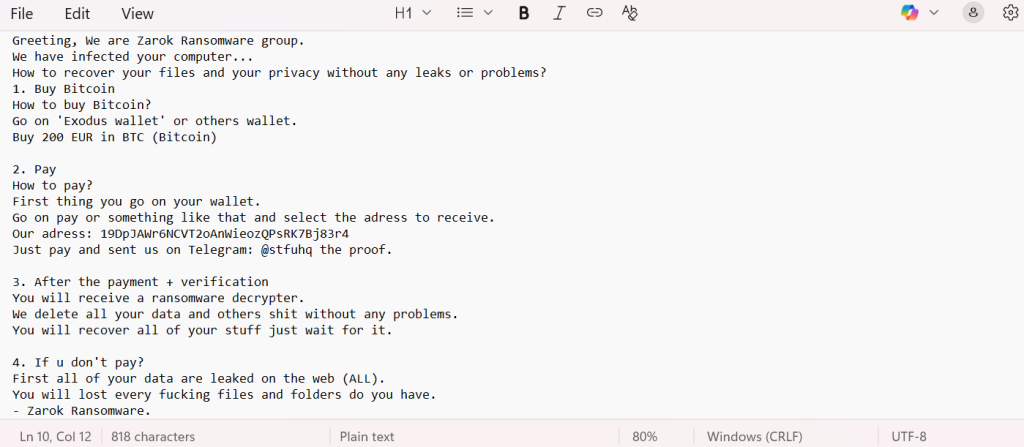
File Name: README_NOW_ZAROK.txt Location: Typically dropped in each directory with encrypted data.
Excerpt:
Greeting, We are Zarok Ransomware group. We have infected your computer… How to recover your files and your privacy without any leaks or problems?
1. Buy Bitcoin How to buy Bitcoin? Go on ‘Exodus wallet’ or others wallet. Buy 200 EUR in BTC (Bitcoin)
2. Pay How to pay? First thing you go on your wallet. Go on pay or something like that and select the adress to receive. Our adress: 19DpJAWr6NCVT2oAnWieozQPsRK7Bj83r4 Just pay and sent us on Telegram: @stfuhq the proof.
3. After the payment + verification You will receive a ransomware decrypter. We delete all your data and others shit without any problems. You will recover all of your stuff just wait for it.
4. If u don’t pay? First all of your data are leaked on the web (ALL). You will lost every fucking files and folders do you have.
Initial Access: Phishing emails, malicious torrents, or software cracks.
Execution: AES/RSA encryption and extension appending.
Persistence: Modifies registry keys for ransom-note display.
Defense Evasion: Deletes shadow copies and disables recovery.
Exfiltration: Transfers stolen data to attacker-controlled servers.
Impact: Data encryption, extortion, potential leaks.
Victim Landscape — Global Reach & Focused Sectors
Regions:
Industries:
Activity Window:
Conclusion
Zarok ransomware exemplifies a new wave of low-cost, high-volume extortionware designed for speed and accessibility rather than precision. Its use of Telegram for negotiation, smaller ransom demands, and a dual threat of encryption and leaks show how modern ransomware operations adapt to exploit victims across different scales. For organizations, early detection, offline backups, and layered email filtering are critical defenses. Individuals should avoid pirated software, maintain OS and antivirus updates, and never engage directly with the attacker’s contact channels. With prompt isolation and professional recovery support, most Zarok incidents can be contained before catastrophic loss occurs.
Frequently Asked Questions
Currently, none exists — stay informed via No More Ransom.
Yes, if clean backups exist or via partial PoC decryption from security professionals.
Phishing attachments, pirated programs, and fake software updates.
Overview Hexalocker ransomware has evolved into one of the most alarming cybersecurity hazards in recent times. Known for infiltrating systems, locking down crucial data, and extorting victims through ransom demands, it continues to impact individuals, businesses, and IT infrastructures alike. As attackers grow more sophisticated, data recovery becomes increasingly complex. This comprehensive guide delves into…
In our recovery lab today at Lockbit Decryptor, we isolated a ransomware strain identified by the actors as M3rx. Our forensic analysis confirms this is a sophisticated, enterprise-targeting ransomware operation. This variant employs a robust hybrid cryptosystem, and our lab has identified a critical flaw in its key exchange protocol that allows for the reconstruction…
Forensic Dissection of the .ftagic041 Ransomware Attack: Inside the Rorschach (BabLock) Architecture Strategic Intelligence Briefing: The BabLock Escalation The appearance of the .ftagic041 file extension on your network is the definitive signature of a targeted breach by the Rorschach (BabLock) ransomware family. Known as one of the fastest and most highly customized encryption engines ever…
Forensic Investigation Report: Deconstructing the LockBit 3.0 Black Ransomware (The .2z0ulF4QF Variant) Strategic Intelligence Briefing: The LockBit 3.0 Builder Leak Exploitation In the ongoing aftermath of the LockBit 3.0 builder leak, an array of independent threat actors and affiliate gangs are aggressively deploying customized versions of the “LockBit Black” encryptor. The forensic engineering division at…
Introduction RCRU64 ransomware has emerged as a significant threat in the cybersecurity landscape, infiltrating systems, encrypting vital files, and demanding ransom in exchange for decryption keys. As the frequency and sophistication of these attacks escalate, individuals and organizations are grappling with the daunting task of data recovery. This comprehensive guide provides an in-depth look at…
Forensic Dissection of HMDL Ransomware: Analyzing the Extensionless AEAD Cryptographic Payload Strategic Intelligence Briefing: The Extensionless Evasion Tactic In September 2026, global incident response telemetry identified a highly deceptive ransomware variant operating under the HMDL identifier. Defying established extortion norms, this payload employs a severe anti-forensic tactic: it does not append an extension to encrypted…