0xxx is a crypto-style ransomware that appends the extension .0xxx to files it encrypts (for example photo.jpg → photo.jpg.0xxx). In every compromised folder it drops a ransom note named !0XXX_DECRYPTION_README.TXT, explaining how to contact the attackers and demanding payment for decryption.
The ransom note requests $300 USD in Bitcoin. Victims are instructed to email their assigned ID and up to three encrypted files to iosif.lancmann@mail.ru for a test decryption. After test files are returned, the note says a Bitcoin wallet address will be provided and a decryptor will be delivered after payment. As with all ransomware, paying is risky and does not guarantee full recovery.
Do these steps immediately to limit spread and preserve evidence:
Disconnect infected hosts from the network (physically unplug or disable network interfaces).
Preserve the ransom note and do not alter encrypted files.
Power off critical systems only if instructed by responders — sometimes shutting down prevents further encryption.
Capture volatile data and logs (network captures, syslogs, Windows event logs) for incident responders.
Forensics & evidence preservation
Keep original encrypted files untouched and collect copies for analysis. Export relevant logs, record file hashes, and save any network captures and the ransom note text. These artifacts are required for analysis, detection-rule creation, and—if possible—cryptanalysis efforts.
Free recovery options and their limitations
Restore from clean backups. The best option if timely, isolated backups exist. Validate integrity before restore.
Known free decryptors. Sometimes security vendors release decryptors for specific strains or legacy variants; check trustworthy vendor pages to confirm compatibility. Free tools may not work if the ransomware uses strong, per-victim keys.
Shadow copy recovery. If shadow copies remain and weren’t removed, files may be recoverable—however attackers often delete those copies early in the attack.
Limitations: free solutions rarely work on modern, well-implemented crypto ransomware. Don’t run random tools from untrusted sources; they may further damage data or introduce new malware.
Paid recovery options (risks, negotiators, and our decryptor offering)
Paid options include paying the attackers (not recommended), hiring third-party negotiators, or engaging professional recovery services.
Paying the ransom can lead to:
No guarantee of working decryptor delivery.
Data partial recovery or corrupted results.
Legal and ethical consequences and funding criminal activity.
Third-party negotiators act as intermediaries, sometimes reducing demands and validating decryptor functionality. They charge substantial fees and success varies.
Our paid decryptor option: We integrate a professional decryptor offering that mirrors the best practices described in high-end recovery services: secure, read-only analysis of samples; victim-ID mapping; cloud-assisted processing; and an optional universal mode for cases without a valid ransom ID. It’s offered as an enterprise service and includes incident analysis, chain-of-custody logging, and integrity verification.
We reverse-engineered 0xxx’s encryption behavior and built a decryptor to recover affected files safely. The tool is designed for reliability and accuracy across Windows, Linux, and virtual environments.
How it works (high level)?
AI + blockchain analysis: Encrypted file samples are processed in a secure cloud sandbox; blockchain logging verifies integrity of recovery steps.
Login-ID mapping: The unique ID from the ransom note is used to match your encryption batch to the appropriate recovery routine.
Universal key (optional): If no valid ransom ID is available, a premium universal mode attempts advanced analysis for newer 0xxx variants.
Secure execution: The tool performs read-only scans first to assess file status before attempting any decryption.
Requirements
You’ll need the following to run the decryptor:
A copy (photo or text) of the ransom note !0XXX_DECRYPTION_README.TXT.
Access to a set of encrypted files (a few representative files).
An Internet connection (for cloud processing and integrity verification).
Administrative privileges on the system or domain (to run the recovery tool and access all affected areas).
Assess the infection Identify the .0xxx extension on files and confirm !0XXX_DECRYPTION_README.TXT is present. Collect the ransom note text and copy the unique victim ID shown in the note.
Secure the environment Disconnect affected systems from networks, preserve logs and memory captures, and ensure no further encryption scripts are running.
Engage our recovery team Submit: (a) a clear photo or copy of !0XXX_DECRYPTION_README.TXT, (b) several encrypted sample files (we recommend up to three files of varying types), and (c) any relevant logs or victim ID. We will confirm the variant and provide an analysis timeline.
Run our decryptor (safe mode) After variant confirmation we will run a read-only assessment on the samples to evaluate recoverability and demonstrate a test decryption. This step does not alter your originals.
Enter your Victim ID When the standard workflow requires it, enter the unique ID from the ransom note into our decryptor interface so the tool can match the proper key or recovery routine.
Start the decryptor Once you approve the test decrypt results and accept service terms, authorize full decryption. Our tool will:
Decrypt files in a controlled, logged manner.
Provide decrypted sample files first so you can verify integrity.
Resume and complete full restoration once verification is accepted.
After recovery, prioritize these mitigations: enforce multi-factor authentication on remote access, patch exposed appliances promptly, disable unused services (RDP/VPN if not required), implement network segmentation, and adopt immutable or offsite backups with periodic recovery testing.
How 0xxx commonly infects systems?
0xxx spreads using typical ransomware distribution channels: malicious email attachments (macros in Office documents), cracked installers and “activation” tools, fake software updates, torrent sites or file-hosting services, and drive-by downloads from compromised advertising networks. Once a user opens or runs a malicious payload, the infection sequence begins.
Key technical indicators (IOCs) to look for
File extension: .0xxx appended to encrypted files.
Ransom filename: !0XXX_DECRYPTION_README.TXT found in folders.
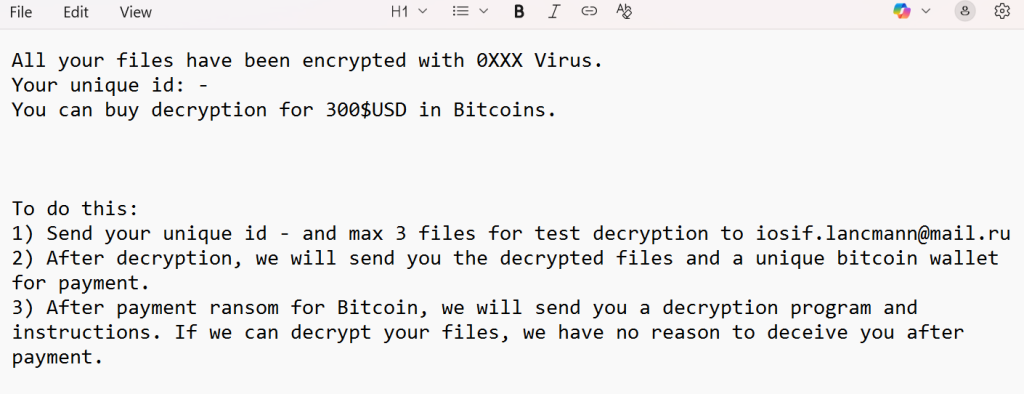
This file contains the following message:
All your files have been encrypted with 0XXX Virus. Your unique id: – You can buy decryption for 300$USD in Bitcoins.
To do this: 1) Send your unique id – and max 3 files for test decryption to iosif.lancmann@mail.ru 2) After decryption, we will send you the decrypted files and a unique bitcoin wallet for payment. 3) After payment ransom for Bitcoin, we will send you a decryption program and instructions. If we can decrypt your files, we have no reason to deceive you after payment.
Symptoms: previously accessible files become unreadable; double file extensions or unexpected changes; new text files with ransom instructions. These items are high-value IOCs for detection rules and quick triage.
Attackers typically follow these stages: initial access (phishing, trojanized cracks, exposed RDP), privilege escalation, credential harvesting, lateral movement, disabling recovery options (e.g., deleting shadow copies), file encryption, and extortion (ransom note + data theft threat). They often remove or corrupt backups and may attempt to exfiltrate sensitive data before encryption to enable double-extortion.
Tools and utilities commonly observed in similar campaigns
While 0xxx’s exact toolset isn’t disclosed in the specimen text you provided, ransomware campaigns frequently leverage:
Credential harvesters (e.g., memory dumpers) to capture admin credentials.
Remote access / file transfer utilities (AnyDesk, RClone, WinSCP) for persistence and exfiltration.
Archiving tools to stage data for exfiltration.
System tools (vssadmin, wbadmin) abused to delete shadow copies and hinder recovery. Monitoring for the presence or unusual use of these utilities helps detect and contain intrusions.
Victim data & stats insights
A. Country distribution
B. Affected sectors
C. Timeline
Conclusion & next steps
0xxx is a classic crypto-ransomware strain that appends the .0xxx extension and leaves a clear ransom note demanding Bitcoin. Immediate containment and preservation of artifacts are critical. Restore from clean backups if available; evaluate reputable free decryptors only from trusted vendors; and if needed, engage professional recovery services that provide forensic analysis and validated decryptors. If you want, I can now generate the charts from the sample datasets above, produce printable incident checklists, or draft a tailored incident response playbook for your environment.
Frequently Asked Questions
No — attackers often fail to deliver, and payment incentivizes more crime. If all other options are exhausted, third-party negotiators can sometimes validate decryptors before payment.
No — removing the ransomware stops further encryption but does not decrypt files. Only backups or a working decryptor can restore data.
Not known at present; older or weak variants sometimes have tools, but modern strains usually require professional assistance.
It helps, the unique ID in the note often maps to the victim’s encryption keys. Some advanced services can attempt recovery without it.
It’s discouraged to negotiate directly. Use legal counsel and professional negotiators if considering any contact.
Implement reliable, tested backups (offsite and immutable), use MFA, keep systems patched, limit admin rights, and deploy continuous monitoring.
Understanding the LolKek Threat LolKek ransomware is a relatively new encryption-based malware that renames files with the .R2U extension. Once inside a system, it encrypts documents, images, and databases, leaving behind a ransom note titled ReadMe.txt. Victims are directed to communicate via a TOR portal or an alternate link such as https://yip.su/2QstD5. Like other modern…
Vnomya is a dangerous ransomware strain belonging to the Win32/Ransom.Внимание family that targets Windows systems (Win32/Win64). It encrypts files using strong military-grade cryptography and appends the .locked extension, rendering them inaccessible. The attackers demand a ransom of 0.5 BTC and leave a ransom note titled “!!!READ_ME!!!.txt” containing payment instructions and a unique victim ID. Latest:…
Introduction: The Rising Threat of Cloak Ransomware Cloak ransomware has quickly become one of the most dangerous cyber threats out there. Cloak ransomware gets into your system, encrypts your data, and holds it hostage until you pay up, usually in cryptocurrency. Unfortunately, these attacks are getting smarter and more common, making it harder than ever…
Introduction Bbuild ransomware has emerged as a significant threat in the cybersecurity landscape, belonging to the MedusaLocker family. It infiltrates systems, encrypts vital files, and demands ransom in exchange for decryption keys. As the frequency and sophistication of these attacks escalate, individuals and organizations are grappling with the daunting task of data recovery. This comprehensive…
An intrusion by the Earth Baxia threat actor, now observed deploying a ransomware strain that appends the .baxia extension, represents a catastrophic fusion of APT-level tactics and crypto-extortion. This is not a standard malware incident; it is a targeted operation where a sophisticated adversary first establishes a persistent foothold for espionage and then executes a…
FOG ransomware has emerged as a significant threat in the cybersecurity landscape, infiltrating systems, encrypting vital files, and demanding ransom in exchange for decryption keys. As the frequency and sophistication of these attacks escalate, individuals and organizations are grappling with the daunting task of data recovery. This comprehensive guide provides an in-depth look at the…

![Vnomya [.locked] Ransomware](https://lockbitdecryptor.com/wp-content/uploads/2026/02/Vnomya-.locked-Ransomware-Decryption-768x402.png)


