Our Specialized Monkey Decryptor — Secure and Expert-Engineered
Our cybersecurity laboratory has created a dedicated decryptor for Monkey ransomware, a Rust-based crypto-ransomware family that encrypts user data using a combination of AES and RSA algorithms. The decryptor is built to:
Safely examine encrypted samples in an isolated environment,
Identify the specific Monkey variant and its victim ID markers, and
Recover files through controlled, verified decryption sessions while maintaining integrity logs and audit reports.
The decryptor operates in both cloud-assisted and offline (air-gapped) configurations, ensuring adaptability for enterprises and government environments. All decryption actions begin in read-only validation mode, guaranteeing forensic safety before recovery.
Once a small set of encrypted samples and the ransom note are submitted, the decryptor conducts a variant fingerprinting process — analyzing file headers, encryption structures, and metadata. It cross-matches these with existing signatures derived from Monkey’s AES+RSA encryption scheme. When a matching pattern or recoverable key component is found, a proof-of-concept (PoC) decryption is carried out on a single test file. Upon successful verification, the full decryption process begins, producing integrity reports and timeline logs for validation, compliance, and insurance purposes.
Requirements:
The ransom note file (How_to_recover_your_files.txt)
2–5 encrypted file samples (copies only) with .monkey extension
Administrator access on the host or recovery environment
Internet access for cloud processing (optional in offline mode)
Immediate Actions After Detecting Monkey Ransomware
Isolate the infected systems immediately. Disconnect endpoints from local networks, shared drives, and cloud-sync platforms to prevent lateral spread.
Preserve encrypted files exactly as found. Do not attempt to rename or open them — doing so may corrupt encrypted data or disrupt key associations.
Capture a RAM dump if possible. Memory snapshots may contain temporary keys or session data critical for decryption analysis.
Collect telemetry and forensic data. Include antivirus logs, event logs, network traffic captures, and timestamped user activity reports.
Engage professionals. Notify your incident response (IR) or digital forensics team immediately. Do not contact the threat actors directly at the provided emails (monkeyransomware@onionmail.org).
How to Recover Files Encrypted by Monkey?
Free Recovery Methods
Backup Restoration: Offline or immutable backups remain the safest recovery option. Before restoring, verify integrity using checksums or controlled mounting. Monkey ransomware may delete shadow copies or compromise online backups, so rely on isolated sources.
VM Snapshot Rollback: If hypervisor snapshots exist (VMware, Hyper-V, etc.), reverting to a pre-attack point can restore service continuity. Always confirm that the attacker did not alter or delete snapshot files.
Paid or Specialized Options
Professional Decryptor Service: Our analyst-driven recovery service begins with sample validation and a PoC decryption to confirm tool compatibility. Once validated, we perform a complete recovery in a controlled environment with real-time monitoring and compliance documentation.
Ransom Payment (Last Resort): While some victims have regained access through ransom payments, the risk of non-delivery or corrupted decryptors is high. Law enforcement and security experts strongly advise against paying. If considered, involve legal counsel and insurers before any negotiation.
How to Use Our Monkey Decryptor — Step-by-Step?
1. Assess the Infection Confirm that encrypted files end in .monkey. Locate the ransom note titled How_to_recover_your_files.txt.
2. Secure the Environment Disconnect infected systems from all networks, including Wi-Fi, VPNs, and mapped drives. Halt further spread.
3. Preserve Critical Evidence Make forensic copies of encrypted data and the ransom note. Compute SHA-256 hashes. Capture RAM memory if tools are available.
4. Contact Our Response Team Use only our secure channel (never the attacker’s email). Provide ransom notes, encrypted samples, and system logs. We’ll supply secure upload instructions.
5. Upload Samples & Hashes Use the assigned HTTPS/SFTP endpoint or offline courier delivery for sensitive environments. Attach a short incident summary and the affected host count.
6. Proof-of-Concept (PoC) Analysis Our analysts identify the Monkey variant and execute a small-file PoC decryption. The results and audit logs are returned for verification.
7. Authorize Full Recovery After confirming the PoC results, sign the recovery agreement outlining scope, confidentiality, and operational schedule.
8. Execute Controlled Decryption The decryptor begins in read-only mode, then decrypts all verified files to a separate storage directory. Analysts supervise and log every action.
9. Validate the Results Check restored files via checksums and functional testing. Keep integrity reports and logs for compliance or insurance use.
10. Cleanup & Reinforcement Remove residual malware, rotate credentials, patch systems, and implement hardened, offline backup policies using the 3-2-1 method (three copies, two media types, one offline).
Overview: Monkey ransomware is a Rust-based crypto-malware that uses hybrid AES+RSA encryption to lock user data and demand payment. Detected variants delete shadow copies, disable recovery, and alter the Windows boot process to block system repair. The ransomware also replaces desktop wallpapers with ransom images and leaves text instructions in How_to_recover_your_files.txt.
Behavior: Monkey encrypts documents, databases, archives, photos, videos, and other valuable files, then appends the .monkey extension (e.g., invoice.pdf.monkey). The ransom note warns against renaming or modifying encrypted files and instructs victims to email the attacker within 24 hours, threatening increased ransom costs and public leaks thereafter.
Distribution: The malware spreads primarily via compromised RDP configurations, phishing emails, fake updates, malicious downloads, trojanized installers, and exploit kits. It may also propagate through removable storage and local networks.
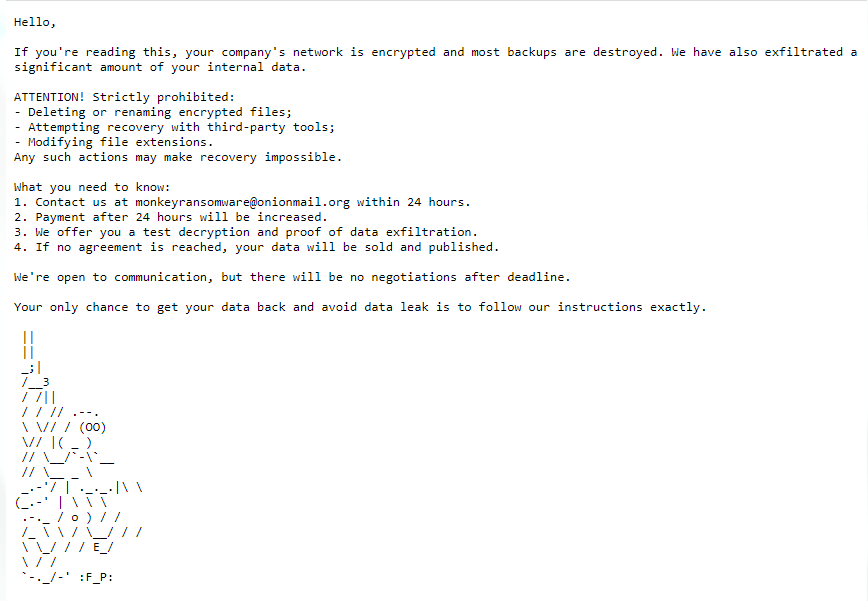
If you’re reading this, your company’s network is encrypted and most backups are destroyed. We have also exfiltrated a significant amount of your internal data.
ATTENTION! Strictly prohibited: = Deleting or renaming encrypted files; = Attempting recovery with third-party tools;
Modifying file extensions.
Any such actions may make recovery impossible.
What you need to know:
Contact us at monkeyransomware@onionmail.org within 24 hours.
Payment after 24 hours will be increased.
We offer you a test decryption and proof of data exfiltration.
If no agreement is reached, your data will be sold and published.
We’re open to communication, but there will be no negotiations after deadline.
Your only chance to get your data back and avoid data leak is to follow our instructions exactly.
IOCs, TTPs & Technical Artifacts
Detections by Major Vendors:
Dr.Web → Trojan.Encoder.43529
BitDefender → Gen:Heur.Ransom.REntS.Gen.1
ESET-NOD32 → A Variant of Win64/Filecoder.Monkey.A
Execution: Deploys an AES+RSA encryption routine, disables recovery tools, and modifies boot configurations.
Persistence: Establishes scheduled tasks and startup entries to maintain execution on reboot.
Exfiltration & Extortion: Transfers sensitive files to remote servers and threatens public leaks to enforce payment.
Impact: Encrypts a wide range of document, image, and database file types; changes desktop wallpaper; and prevents Windows recovery options.
Victim Landscape — Global Scope & Impact
Target Geography:
Affected Industries:
Infection Timeline:
Conclusion — Contain, Analyze, and Recover Safely
Monkey ransomware represents a modern evolution of crypto-malware — fast, secure, and difficult to brute-force due to its AES+RSA hybrid encryption and Rust-based obfuscation. Victims should prioritize:
Immediate containment and evidence preservation,
Verified decryption through professional services (proof-of-concept required), and
Long-term resilience via hardened RDP, patching, and the 3-2-1 backup rule.
Never attempt ad-hoc decryption or pay ransoms directly. Use documented evidence, retain all hashes, and coordinate with forensic experts and law enforcement.
Frequently Asked Questions
Currently, there is no publicly available decryptor. Users should monitor trusted sources such as No More Ransom for updates.
The malware exploits weak RDP credentials, malicious spam attachments, trojanized software, or fake update installers.
Rust offers strong memory safety and cross-platform portability, making detection and reverse engineering more difficult.
No. Payment offers no guarantee and supports further criminal activity. Consider it only after legal review and insurer authorization.
Common file types include documents, PDFs, photos, videos, databases, and archives — effectively any valuable user data.
Maintain updated software, enforce MFA on RDP, disable unnecessary remote services, implement network segmentation, and maintain offline, immutable backups.
In our recovery lab today at Lockbit Decryptor, we isolated an active MedusaLocker variant appending the .net extension, with observed suffixes including .net2, .net5, .net6, .net10, .net12, .net15, and .net50. Files are renamed following a clear pattern, such as 1.jpg.net15, sample.pdf.net50, and 1.xlsx.net12. This strain propagates through compromised RDP and initiates contact via a Tor…
Forensic Dissection of Mimic Ransomware: Analyzing the Massive “Echo” Extension and Interrupted Execution Vectors Strategic Intelligence Briefing: The Mimic (Pay2Key) Architecture Global incident response telemetry has cataloged a highly distinctive ransomware campaign operating under the Mimic (historically tied to Pay2Key) lineage. Often misidentified by automated systems due to its exceptionally long, Base64-like file extensions—such as…
Overview: Understanding the CyberVolk BlackEye Ransomware Menace CyberVolk BlackEye ransomware has emerged as one of the most disruptive forms of cyberattacks in recent years. This malicious software encrypts vital data and demands ransom payments, placing individuals, businesses, and IT infrastructures in a high-stakes situation. As ransomware tactics evolve, regaining access to compromised files becomes increasingly…
Our JustIce Decryptor: Expert-Engineered and Exact After in‑depth analysis, our cybersecurity team reverse-engineered the JustIce encryption process. We developed a reliable decryptor tool that has restored files for multiple victims globally. Compatible with Windows environments, it aligns precisely with the encryption batch ID found in ransom notes. The decryptor emphasizes reliability, integrity checks, and data…
Inside the LockBit 3.0 Ecosystem LockBit 3.0 Black, the latest iteration of the infamous LockBit ransomware family, continues to evolve in 2025 with precision-engineered encryption and aggressive double-extortion tactics.This newly observed variant appends random 9–10 character extensions such as “.AZrSRytw3” to encrypted files and leaves a ransom note named “AZrSRytw3.README.txt.” Victims report that all local…
Overview of KillBack Ransomware KillBack ransomware is a file-locking malware that encrypts data and appends a unique ID followed by the .killback extension to each file. Victims also receive a ransom note titled README.TXT, demanding payment in Bitcoin within 24 hours. Like most modern ransomware, KillBack emphasizes pressure tactics, including threats of permanent data loss…





One Comment