The .crypz strain is an emerging ransomware noted in community incident reports. Our response team engineered a .crypz Decryptor workflow that combines deep triage, safe test restores, and controlled decryption attempts where feasible. It’s designed for reliability and auditability across Windows and virtualized environments, emphasizing data integrity at every step.
AI + Blockchain Analysis: Encrypted samples and ransom notes are analyzed in a secure cloud; integrity of recovered items is logged on an auditable ledger. Login ID-Based Mapping: The tool uses the Victim ID from the ransom note to align decryption parameters with the specific case. Universal Key (Optional): If a ransom note is missing, a premium workflow attempts variant-agnostic mapping where technically possible. Secure Execution: The process starts with read-only scans to validate eligibility and avoid corruption.
Internet access for cloud verification (offline mode available)
Local or domain admin privileges for recovery tasks
Immediate Steps to Take After a .crypz Ransomware Attack
Disconnect Immediately Isolate affected endpoints and servers from networks, shares, and sync services to stop spread.
Preserve Everything Keep the note and encrypted files untouched. Retain logs, memory captures, and network traces for analysis.
Avoid Power Cycling Reboots or formatting can trigger additional encryption or remove potential recovery artifacts.
Engage a Recovery Expert Unverified tools can damage data. Work with responders experienced in emerging and un-attributed strains.
How to Decrypt .crypz Ransomware and Recover Your Data?
The .crypz operation uses a ransom note named Crypz-README.txt, appends the .crypz extension, and directs victims to contact decCrypz@onionmail.org or a provided TOX ID. Recovery hinges on variant identification, careful sample handling, and safe, staged decryption trials without risking further loss.
.crypz Decryption and Recovery Options
Free Methods
1) ID-Ransomware / NoMoreRansom Checks Submit the ransom note and an encrypted sample for fingerprinting. Early reports show no public decryptor yet, but databases update frequently; recheck after new submissions.
2) Backup Restore Offline or off-site backups remain the fastest clean return to service. Validate snapshots with hashes or mount tests before restoring to sanitized hosts.
3) VM Snapshots If hypervisors maintain pre-attack snapshots, revert after isolating management planes. Confirm snapshot integrity and logs to ensure they weren’t touched by the threat.
Paid Methods
Paying the Ransom Attackers claim price doubles after 48 hours and offer two small test decrypts (<2 MB total, non-critical). Payment risks include non-delivery, partial/broken decryptors, or backdoors. Legal, regulatory, and ethical implications must be assessed with counsel.
Third-Party Negotiators Specialists can handle TOR/TOX/email communication, request proof decryption, and seek reductions. Costs can be significant and outcomes are not guaranteed.
Our Specialized .crypz Ransomware Decryptor We operate a case-by-case decryptor workflow tailored to .crypz incidents. It reverse-engineers artifacts, leverages note-derived IDs, and runs controlled decryption in sandboxed infrastructure. Results include audit logs and integrity proofs for compliance and forensics.
How It Works? Reverse-Engineered Utility: Built on encryption-flow research and structured defect testing. Cloud-Based Decryption: Proprietary engines attempt safe restores with verifiable logs. Fraud Risk: We verify provenance and discourage up-front tools that lack analysis or references.
Step-by-Step .crypz Recovery Guide with .crypz Decryptor
Assess the Infection: Confirm the .crypz extension and the presence of Crypz-README.txt.
Secure the Environment: Disconnect impacted systems and halt any suspicious tasks or scheduled jobs.
Engage Our Recovery Team: Share the ransom note, several .crypz samples, and available logs for variant validation and a recovery plan.
Run Our Decryptor: Launch as administrator in an isolated environment. Internet access may be required for ledgered integrity checks.
Enter Your Victim ID: Copy the Victim ID from the note so the workflow maps to your case precisely.
Start the Decryptor: Begin with sample files; once verified, expand to full batches and export clean results.
Offline vs Online Decryption Methods Offline is suitable for air-gapped environments via removable media and secure boot kits. Online enables faster triage, expert oversight, and audit logging through encrypted channels. Our workflow supports both modes for enterprise, government, and industrial settings.
What is .crypz Ransomware?
.crypz is an unattributed ransomware observed in 2025 incidents. It appends .crypz to files, drops Crypz-README.txt, and instructs victims to email decCrypz@onionmail.org or contact a specific TOX ID. The note requests the Victim ID in the subject line and promises two small test decrypts.
Possible Lineage & Affinities
Community moderators observed that the note style resembles certain C77L/X77C notes, yet no conclusive family match has been announced. Treat the strain as unknown/novel until cryptographic markers or code reuse are confirmed.
How .crypz Works: The Inside Look
Initial Access Vectors: How .crypz Gets In
Trojanized Software Update Victims reported running a file named ServiceInstaller673.exe during a Sepidar v6.1.2 update tied to TinyHidDongle support. One AV flagged it as a trojan; others did not. This suggests a possible dropper/supply-chain angle that requires formal malware analysis.
User-Executed Installers If the dropper path is confirmed, execution relies on a user-run installer, often with elevated privileges.
Email or RDP (Unconfirmed Here) Common across ransomware generally, but not evidenced in the current reports. Keep defenses aligned regardless.
Tools, TTPs & MITRE ATT&CK Mapping
Credential Harvesting Techniques Not explicitly reported; prepare for T1003-style dumping in broader investigations.
Reconnaissance and Network Mapping No tools were posted by victims; assume standard host discovery until proven otherwise.
Defense Evasion Methods Actors typically leverage signed/legitimate processes, scheduled tasks, or script hosts; log tampering is possible but unconfirmed.
Data Exfiltration Tools and Techniques No exfil claims in the note. Monitor for T1048/T1567 behaviors while scoping the incident.
Encryption and Data Destruction Files end in .crypz; note permits two test decrypts and threatens 48-hour price doubling. Shadow-copy deletion is likely in ransomware playbooks but unverified here.
Use of Legitimate Administrative Utilities Nothing specific reported; stay alert for built-in tools used “LOLBins” style.
Encryption & Extortion Techniques
The note indicates classic encrypt-then-negotiate behavior, with a pressure window that doubles the ransom after 48 hours. The Victim ID normalizes communications, and the two-file test aims to establish trust without revealing tooling.
Known .crypz Indicators of Compromise (IOCs)
Encrypted Extension: .crypz Ransom Note: Crypz-README.txt (seen at drive root and across folders) Attacker Contact: decCrypz@onionmail.org Secondary Channel:TOX with a long public ID provided in the note Victim ID: short alphanumeric string to include in email subject Suspected Dropper (Case Reports): ServiceInstaller673.exe from a Sepidar update path
Mitigations and Best Practices
Harden remote access with MFA and lockouts. Patch and inventory third-party software and software update channels. Enforce application control and EDR with script blocking. Segment networks and protect backups with immutability and off-site retention. Maintain continuous monitoring and incident response readiness.
Statistics and Facts So Far Regarding .crypz Ransomware
Top Countries Affected
Organizations Hit by .crypz Ransomware
A Timeline of .crypz Activity (Sep–Oct 2025)
Ransom Note Dissected: What They Say and Why
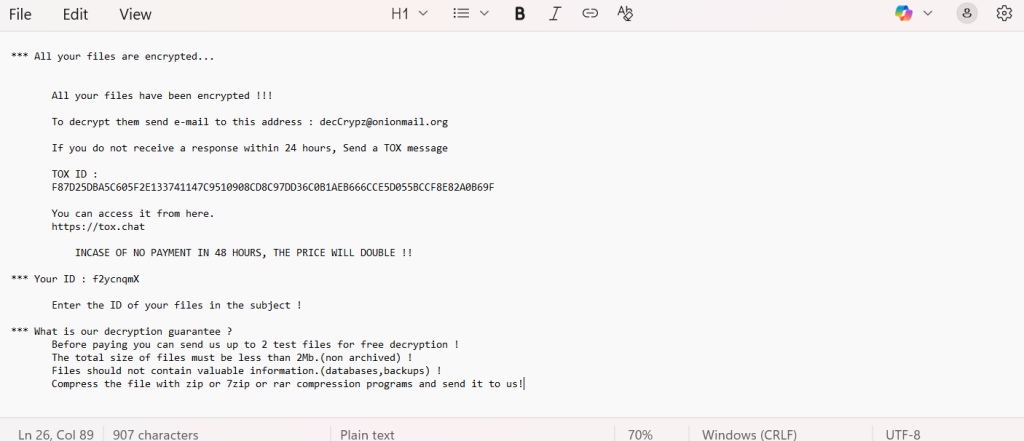
*** All your files are encrypted…
All your files have been encrypted !!!
To decrypt them send e-mail to this address : decCrypz@onionmail.org
If you do not receive a response within 24 hours, Send a TOX message
INCASE OF NO PAYMENT IN 48 HOURS, THE PRICE WILL DOUBLE !!
*** Your ID : f2ycnqmX
Enter the ID of your files in the subject !
*** What is our decryption guarantee ?
Before paying you can send us up to 2 test files for free decryption !
The total size of files must be less than 2Mb.(non archived) !
Files should not contain valuable information.(databases,backups) !
Compress the file with zip or 7zip or rar compression programs and send it to us!
Conclusion: Restore Your Data, Reclaim Your Network
While .crypz ransomware remains unattributed, disciplined containment, evidence preservation, and expert-led recovery put full restoration within reach. Avoid rushed decisions and untrusted tools. With structured analysis, safe test decrypts, and a hardened rebuild, you can return to operations with confidence.
Frequently Asked Questions
No public decryptor is available at this time; recheck as signatures and tools evolve.
Yes. The Victim ID in Crypz-README.txt helps map your case during analysis and any decryption attempts.
It marks files encrypted by this strain and is your primary on-disk indicator.
When handled by vetted teams, encrypted channels and ledgered integrity checks provide verifiable outcomes.
Duration depends on data volume, storage performance, and findings during triage; staged test decrypts speed assurance.
Payment carries legal, financial, and operational risks with no guarantee. Consult counsel and responders before considering any communication.
Overview Helper ransomware has become one of the most formidable threats in today’s cybersecurity landscape. This malicious software invades systems, encrypts crucial data, and demands ransom payments from its victims. As attacks evolve and spread globally, restoring compromised files without paying the ransom has become a top concern for both enterprises and individual users. This…
In our recovery lab today at Lockbit Decryptor, we isolated the Shinra v2 ransomware strain using the .73c extension and the #Howtorecover.txt note. Our forensic analysis confirms this variant employs a hybrid encryption scheme. While it uses a robust combination of ciphers, our lab has identified a critical flaw in its key generation routine that…
Our Solara Decryptor: Engineered for Fast & Accurate Recovery Solara ransomware, based on the Chaos framework, encrypts user files, adds the .solara extension, and leaves behind a ransom note named read_it.txt. Our cybersecurity team has reverse-engineered its encryption logic and developed a professional-grade decryptor capable of restoring files on Windows environments. Designed for precision, our…
Understanding the Threat: What is 3AM Ransomware? 3AM ransomware has rapidly emerged as a formidable cybersecurity menace. Known for its ability to breach secure networks, encrypt vital files, and extort victims for payment, it targets both individuals and large enterprises. As ransomware becomes more complex, data recovery continues to challenge even the most prepared organizations….
Advanced Decryptor for BQTLOCK BQTLOCK ransomware has quickly emerged as a disruptive cyber threat, encrypting files with the “.BQTLOCK” extension and leaving victims locked out of their systems. Our security team has analyzed its encryption techniques and engineered a professional decryptor capable of restoring encrypted files across Windows, Linux, and VMware environments. Unlike random online…
Introduction: Understanding the Magniber Threat Magniber ransomware(2022-2024) has been targeting individuals and organizations alike. By encrypting critical files and demanding payment in exchange for access, this malware wreaks havoc on its victims. As these attacks grow increasingly sophisticated and pervasive, recovering encrypted data has become a significant challenge. This guide offers an in-depth examination of…






2 Comments