The Privaky ransomware (.lbon) is a newly surfaced encryption threat derived from the Chaos ransomware family, capable of locking your files and demanding ransom payments in Bitcoin. Designed to paralyze victims by encrypting documents, databases, and media, Privaky has already impacted individuals and organizations globally.
This guide explores every aspect of the attack — from infection vectors and encryption mechanisms to step-by-step recovery strategies, including both free and paid decryption options.
Understanding Privaky Ransomware: A Modern Chaos Variant
Privaky is a sophisticated ransomware variant built upon the Chaos ransomware source code. It encrypts files and appends a random four-character extension such as .lbon, .zfxa, or .yuer, effectively locking victims out of their data. Once encryption is complete, a ransom note named “read_it.txt” appears, warning victims that all personal files have been encrypted and demanding Bitcoin payment for decryption.
This ransomware campaign communicates through Telegram (@Privaky) and operates under a ransomware-as-a-service (RaaS) model. Its primary goal is financial extortion, with promises of decrypting three files for free to build trust before payment.
Privaky employs hybrid encryption, combining symmetric file encryption with asymmetric key protection. This dual approach ensures rapid encryption while making unauthorized decryption nearly impossible without the attackers’ private keys.
The process begins by scanning local and network drives, selecting target file types (documents, spreadsheets, photos, archives), and encrypting them using a randomized key. Once completed, the ransomware deletes temporary files, appends the new extension, and generates the ransom note.
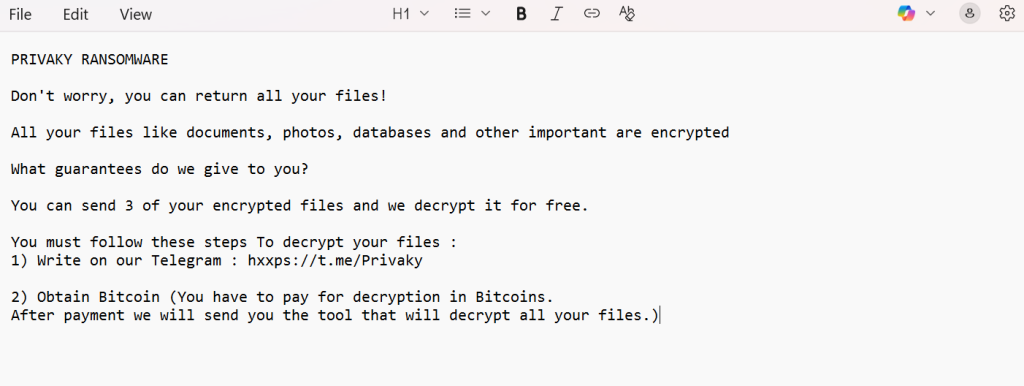
The “read_it.txt” ransom note includes the attacker’s Telegram contact and instructions to pay in Bitcoin. The note typically reads:
PRIVAKY RANSOMWARE
Don’t worry, you can return all your files!
All your files like documents, photos, databases and other important are encrypted
What guarantees do we give to you?
You can send 3 of your encrypted files and we decrypt it for free.
You must follow these steps To decrypt your files : 1) Write on our Telegram : hxxps://t.me/Privaky
2) Obtain Bitcoin (You have to pay for decryption in Bitcoins. After payment we will send you the tool that will decrypt all your files.)
Immediate Response Plan After Privaky Infection
If you suspect your system is infected with Privaky ransomware, timing is everything. Here’s what to do immediately:
Disconnect from all networks — isolate the infected devices to prevent Privaky from spreading across shared drives or servers.
Preserve evidence — do not delete ransom notes or encrypted files; retain system logs, network traffic dumps, and hashes for investigation.
Avoid rebooting or reformatting — these actions can trigger secondary encryption or wipe essential recovery traces.
Engage cybersecurity professionals — early technical evaluation significantly increases your chance of successful data recovery.
How Privaky Ransomware Propagates?
Privaky uses several distribution channels to infect victims, including:
Phishing Emails: Malicious attachments disguised as invoices or HR files.
Drive-by Downloads: Hidden scripts embedded in compromised websites.
Trojan Loaders: Secondary infections through malware droppers.
Pirated Software and Fake Updates: Bundled executable payloads.
Removable Devices: Self-replication via USB drives or shared network folders.
Free Recovery Options and Techniques
While Privaky is complex, certain recovery methods may restore files under specific conditions.
1. Official Backups and Shadow Copies
If backups exist on unplugged or off-site storage, these are your safest recovery options. Administrators should verify the integrity of each snapshot using checksums before restoration. However, Privaky often deletes Windows Volume Shadow Copies, rendering this method unreliable unless offline backups were created beforehand.
2. Public Decryptors and Security Tools
Some Chaos-based variants were previously cracked using decryptors for older versions, but Privaky uses advanced key obfuscation, which blocks those tools. Still, forensic researchers continue analyzing Privaky’s encryption flaws to develop new decryptors in the future.
3. Data Carving and Partial Recovery
In some rare instances, forensic data recovery tools can retrieve partially encrypted files, depending on file structure and encryption progress. This process works best for large media files like videos or archives that were only partially processed before encryption was interrupted.
Paid Decryption and Professional Assistance
When free methods fail, professional decryption remains the most effective (though costly) approach. Below are legitimate paid recovery pathways.
1. Our Privaky Decryptor Solution
Our dedicated Privaky Decryptor was developed after analyzing the Chaos-based encryption algorithms. It uses AI-assisted cryptanalysis and blockchain verification to safely recover encrypted data.
How It Works:
Uses the unique login ID found in the ransom note to map your specific encryption batch.
Executes a read-only scan to assess file integrity before decryption.
Operates via a secure cloud infrastructure that ensures no data leaks or corruption.
Supports Windows environments and compatible virtualized instances.
Requirements:
Access to the ransom note (read_it.txt)
Encrypted file samples
Internet connection for server-side decryption
Administrative privileges on the affected system
Our decryptor can also function offline, upon request, for air-gapped or classified infrastructures.
Step-by-Step Privaky Recovery Guide with Privaky Decryptor
Assess the Infection Identify the encrypted file extensions — such as .lbon or other random four-character suffixes — and confirm the presence of the ransom note read_it.txt in affected directories.
Secure the Environment Disconnect all affected systems from the network immediately to prevent Privaky from spreading. Ensure no further encryption scripts or executables are running in the background.
Engage Our Recovery Team Submit several encrypted files along with the ransom note for variant verification. Our specialists will analyze your case and provide confirmation before initiating the recovery process.
Run Our Decryptor Launch the Privaky Decryptor as an administrator to ensure full access. An active internet connection is required since the tool communicates with our secure cloud infrastructure.
Enter Your Victim ID: Locate the unique Victim ID from the ransom note (read_it.txt) and enter it into the decryptor when prompted. This allows the tool to match your specific encryption pattern.
Start the Decryptor: Click “Start” to begin the decryption process. The tool will connect to our secure servers, retrieve the matching decryption parameters, and restore your files to their original state safely and efficiently.
Some organizations turn to ransom negotiators who communicate directly with the threat actors to reduce payment demands and validate decryptor authenticity. While this approach occasionally results in faster data recovery, it is risky and ethically questionable. Payment does not guarantee file restoration and may violate local cybercrime laws.
3. Ransom Payment Risks
Even if victims pay the ransom, attackers often fail to provide functioning decryption tools or may deliver malware-laden utilities. Moreover, paying incentivizes further attacks and funds criminal activity. Always attempt professional recovery first before considering ransom payment.
Technical Analysis: Privaky’s TTPs and Toolset
Privaky’s operations align with known MITRE ATT&CK tactics and techniques. Below is a breakdown of its behaviors and utilities.
Initial Access
Phishing emails with weaponized attachments
Exploiting weak RDP or VPN credentials
Trojanized downloads from compromised sites
Execution and Privilege Escalation
Runs executables with MSIL framework injection
Uses PowerShell for script execution and privilege escalation
Persistence
Creates registry entries for startup execution
Drops secondary payloads for scheduled persistence
Defense Evasion
Disables antivirus services
Deletes shadow copies and system restore points
Credential Access and Discovery
Employs tools similar to LaZagne and Mimikatz to harvest credentials
Scans internal networks for open SMB or RDP ports
Exfiltration and Impact
Exfiltrates sensitive data prior to encryption
Uses Telegram API for C2 communication
Encrypts documents, images, databases, archives, and backups
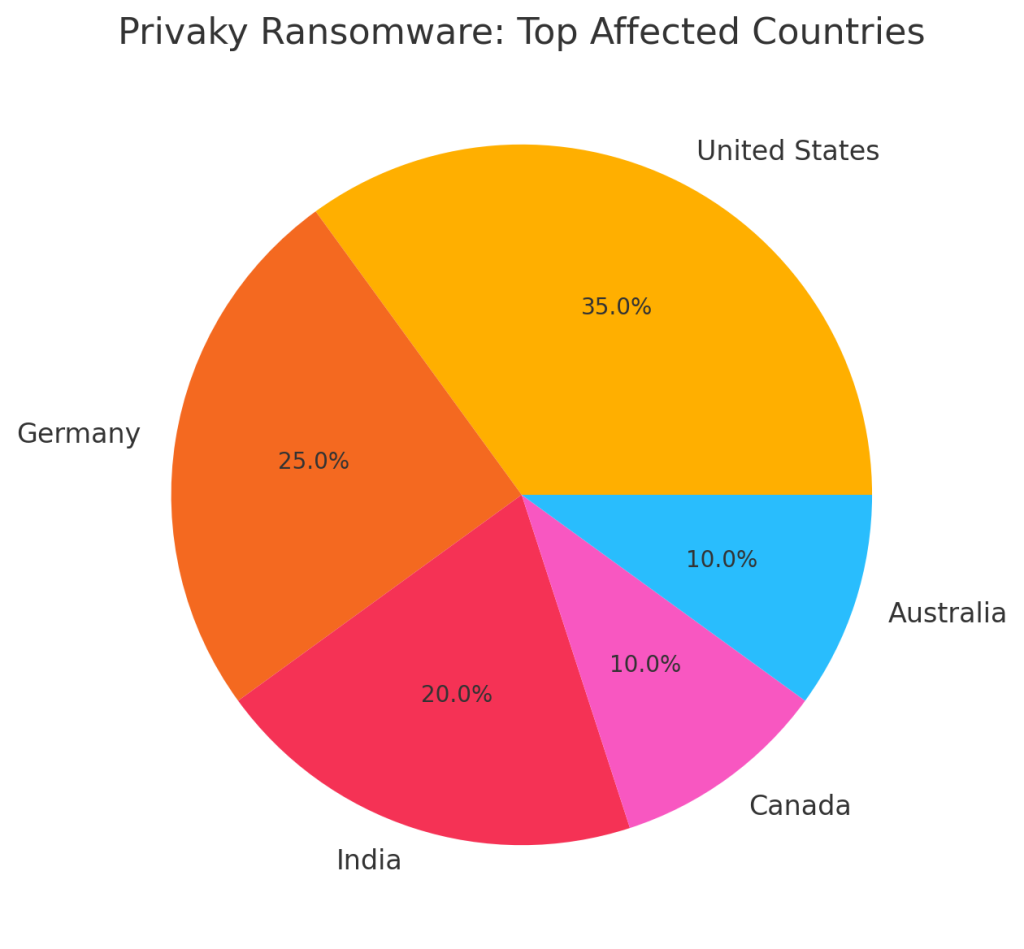
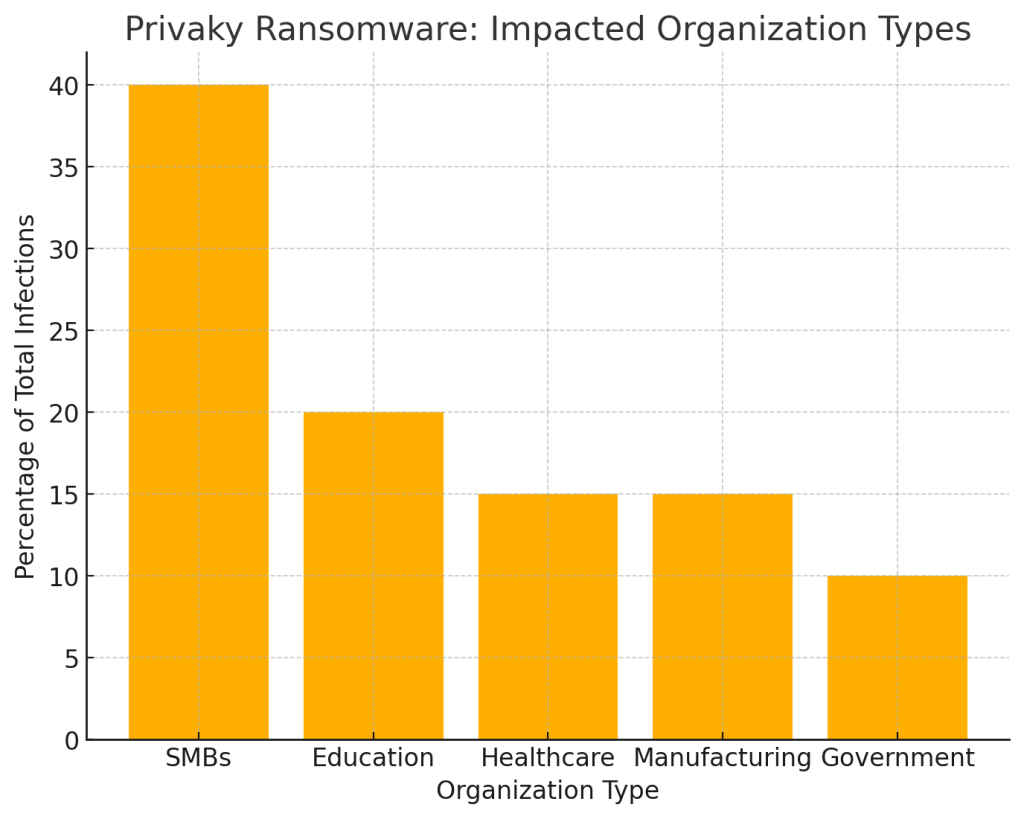
Privaky infections have spread globally, with incidents reported in North America, Europe, and Asia-Pacific regions. Targeted sectors include education, healthcare, manufacturing, and small enterprises.
Top Affected Countries
Organizations Impacted
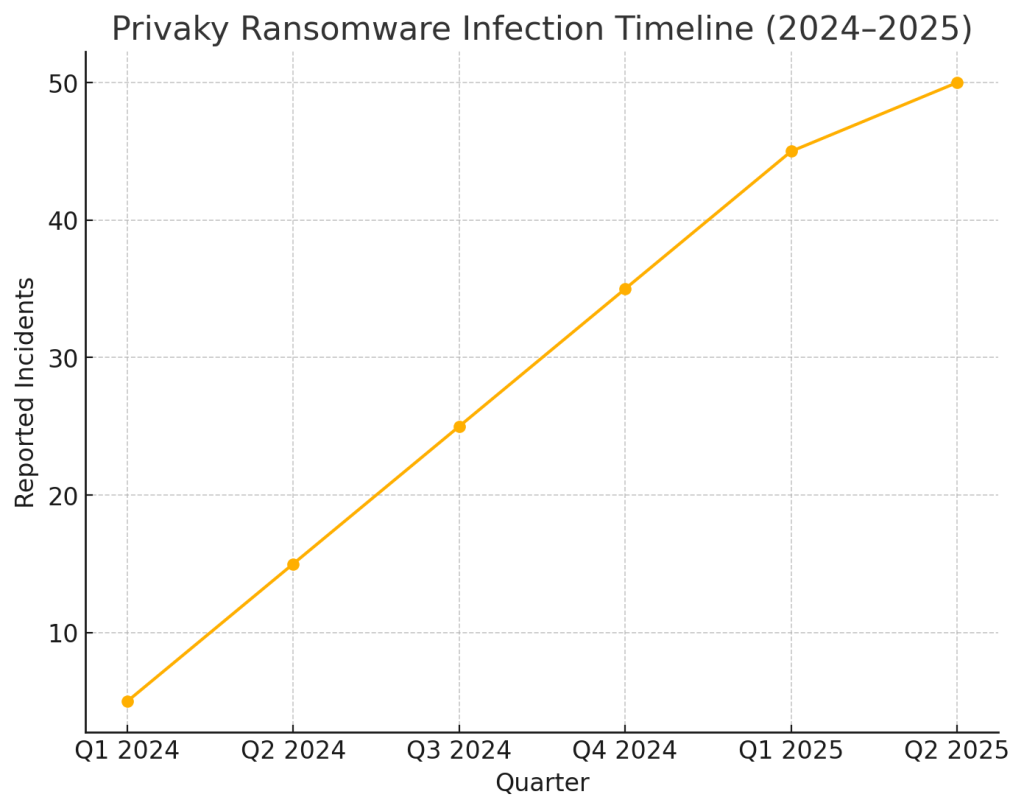
Timeline of Privaky Attacks
Defensive Recommendations and Best Practices
Use MFA for all remote connections to prevent brute-force access.
Patch vulnerabilities in network appliances and VPNs.
Segment networks to contain breaches and protect critical servers.
Implement EDR and continuous monitoring to detect anomalies early.
Maintain immutable backups stored offline or on cloud snapshots.
Conclusion: Recover, Restore, and Reinforce
Privaky ransomware is a formidable threat that combines stealth, speed, and extortion. While decryption without the key is nearly impossible, recovery is achievable through structured incident response and expert-guided decryption solutions. Our Privaky Decryptor has already restored numerous encrypted systems across sectors. With the right tools, swift action, and professional support, even the most destructive ransomware event can be reversed.
Frequently Asked Questions
Currently, no public decryptor exists for Privaky. Recovery requires backups or professional decryption tools.
Yes, it contains your unique encryption ID, crucial for mapping decryption keys.
No. Payment doesn’t guarantee recovery and supports criminal networks.
Windows, server environments, and certain virtualized infrastructures.
Depending on file size, our cloud decryptor typically restores files within a few hours.
Yes, it can propagate through shared folders and removable drives.
The DEVMAN 21 ransomware represents a significant threat to both individuals and organizations, combining file encryption with the malicious exfiltration of sensitive data. Identified by its distinctive .devman21 file extension and the !!!_README_!!!.txt ransom note it leaves behind, this malware can bring productivity to a grinding halt. For a long time, victims faced the grim…
Introduction to Traders Ransomware Traders ransomware is a malicious encryption threat designed to lock users out of their data and demand payment for recovery. Identified on VirusTotal, this ransomware appends the .traders extension to compromised files, leaving victims unable to access their documents, photos, and databases. Like many modern ransomware strains, Traders also delivers a…
Overview Weyhro ransomware has become a great cybersecurity challenge, infiltrating systems, encrypting essential data, and extorting victims through ransom demands. As these attacks grow increasingly sophisticated and prevalent, the challenge of data recovery has intensified for both individuals and organizations. This comprehensive guide explores the intricacies of Weyhro ransomware, its consequences, and the array of…
A Cod ransomware attack can break the rhythm of a normal workday in an instant. Documents that opened seconds earlier suddenly fail to launch, their icons shift, and their names stretch into lengthy, unfamiliar strings such as: 1.jpg.[2AF20FA3].[coddecryptor@hotmail.com].cod This naming pattern confirms that Cod — a member of the Makop ransomware family — has encrypted…
Our RTRUE Decryptor: Expert-Engineered, Secure Recovery Our cybersecurity team has reverse-engineered the RTRUE ransomware’s cryptographic behavior to build a custom decryptor. This decryptor is compatible with all major Windows versions and is tailored to ensure safe recovery of encrypted data with the “.RTRUE” extension. Related article: How to Remove Dev Ransomware and Restore .DEV Encrypted…
In our recovery lab today at Lockbit Decryptor, we isolated the Elite Enterprise ransomware strain. Our analysis confirms this is a highly destructive, enterprise-targeting operation. Its defining characteristic is the absence of file extensions, making initial identification difficult. It employs a standard AES-256 + RSA-4096 hybrid cipher but couples it with catastrophic system-wiping actions, including…


3 Comments