Our expert team has reverse-engineered the encryption logic behind the C77L / Nullhexxx ransomware family, which appends extensions such as .[nullhex@2mail.co].386355D7 to encrypted files.
AI + Behavioral Analysis: Your encrypted files are safely analyzed in an isolated forensic environment using our AI-assisted key mapping algorithm, which recognizes patterns in C77L’s AES-RSA hybrid encryption structure.
Decryption ID Mapping: Every infection contains an 8-character hexadecimal ID (for example {386355D7}) that appears in both the ransom note and encrypted filenames. Our system uses this ID to match potential decryption keys.
Universal Key Matching (Optional): For cases where the ransom note or ID is missing, our premium decryptor can attempt key reconstruction using known C77L entropy models.
Secure Execution: All processes are read-only and fully logged before attempting file recovery.
A copy of the ransom note (#Recover-Files.txt, READ-ME.txt, or READ-ME-Nullhexxx.txt)
Sample encrypted files with .386355D7 extension
The 8-character Decryption ID from the note (example: {386355D7})
Administrator or root privileges on the affected machine
Optional: network logs or memory dumps from the infection period
Immediate Steps to Take After a C77L / Nullhexxx Ransomware Attack
Disconnect Immediately
Isolate infected systems from the network to stop the ransomware from spreading to shared drives and backups.
Preserve Everything
Do not delete ransom notes or encrypted files. Keep all evidence intact—file samples, logs, and event traces may contain vital recovery clues.
Immediately Shut Down Compromised Systems
Avoid rebooting infected machines. C77L often leaves encryption threads active that could re-launch on reboot, causing further data damage.
Contact a Ransomware Recovery Expert
Do not attempt DIY decryptors or unverified tools. Contact professional recovery analysts experienced in hybrid AES–RSA decryption to maximize your chances of safe recovery.
How to Decrypt C77L / Nullhexxx Ransomware and Recover Your Data?
C77L (also identified as X77C or Nullhexxx) is a powerful encryption-based ransomware targeting Windows and NAS environments. It uses AES-256 for file encryption and RSA-2048 to protect session keys, making brute-force recovery virtually impossible without the private key.
Our specialized C77L Decryptor is built to help victims safely analyze and recover files affected by this variant. Whether your files are locked with the .386355D7 or other C77L extensions, our system can map unique IDs, identify exploitable encryption weaknesses, and guide recovery without paying a ransom.
C77L / Nullhexxx Decryption and Recovery Options
Below are the top four practical approaches for recovering from a C77L / Nullhexxx ransomware attack:
1. Free Methods
Backup Restore
If offline or immutable backups exist, they provide the safest recovery route. Always verify integrity using checksums to ensure backups were not encrypted or altered.
VM Snapshots
VM snapshots created prior to the attack can allow instant rollback. Ensure hypervisors are clean and that snapshot logs confirm integrity before applying them.
Manual Forensic Recovery
Some analysts attempt partial recovery using entropy differentials and volume shadow copies (if not deleted). This works only on incomplete encryptions.
2. Paid Methods
Paying the Ransom
While paying the ransom may provide the decryptor from attackers, it’s not recommended. There’s no guarantee the provided tool will work or that stolen data won’t be sold later.
Victim ID Validation: Attackers use the {386355D7}-style ID to deliver victim-specific keys.
Risks: Decryption tools from attackers sometimes lead to corrupted data or hidden malware. Paying also potentially violates cybercrime laws.
Legal Implications:
Ransom payments can trigger legal obligations and compliance reviews. Always consult cybersecurity and legal professionals before considering this option.
3. Third-Party Negotiators
Intermediary Bargaining
Experienced negotiators can safely communicate with the threat actors, confirm decryption validity, and attempt to reduce ransom demands.
Ransom Validation
Negotiators typically request free file samples for testing before any transaction.
Costs
Fees depend on ransom size or fixed retainers; negotiations may still take days or weeks.
After intensive research into ransom samples, encryption IDs, and file structures, our team has developed a specialized decryptor for C77L and its Nullhexxx variants.
How It Works?
1. Reverse-Engineered Logic: Analyzes the AES key generation pattern, the encrypted header, and potential flaws in key wrapping.
2. Cloud-Based Sandbox Decryption: Encrypted files are safely processed in a secure environment. Every operation is monitored and logged for integrity.
3. Offline Mode: For sensitive networks or classified systems, our decryptor runs locally without any internet requirement.
4. Fraud Prevention: Beware of fake decryptor tools circulating online—many are disguised trojans or scams. Always verify with certified recovery professionals.
Step-by-Step C77L Recovery Guide with the C77L Decryptor
1. Assess the Infection
Confirm that encrypted files follow the format: filename.ext.[nullhex@2mail.co].386355D7 and that the ransom note matches known Nullhexxx text.
2. Secure the Environment
Disconnect affected machines and back up encrypted data for safekeeping.
3. Engage the Recovery Team
Submit encrypted files and the ransom note to analysts for variant identification.
4. Run the C77L Decryptor
Launch the decryptor with administrator rights, input your Decryption ID ({386355D7}), and start the recovery session.
5. Verify Output
Recovered files will appear in designated safe directories with automatic integrity verification.
Offline Methods: Ideal for air-gapped systems and environments where external connectivity is restricted. Uses local computation and hardware-based key analysis.
Online Methods: Recommended for large-scale enterprise recovery. Utilizes encrypted cloud communication, real-time progress tracking, and analyst support.
Our decryptor supports both modes for flexibility across corporate, government, and industrial systems.
What is C77L / Nullhexxx Ransomware?
C77L (also called X77C or Nullhexxx) is a Ransomware-as-a-Service (RaaS) variant discovered on Windows and NAS systems. It encrypts files using AES-256 with RSA-2048 for key protection and modifies filenames to include an attacker email and victim ID, such as: .[nullhex@2mail.co].386355D7.
Key Characteristics:
Fast encryption speed and system-wide reach
Deletes shadow copies and disables recovery options
Ransom note instructs victims to email nullhex@2mail.co or use TOX messenger
Common ransom note files: #Recover-Files.txt, #Restore-My-Files.txt, READ-ME.txt
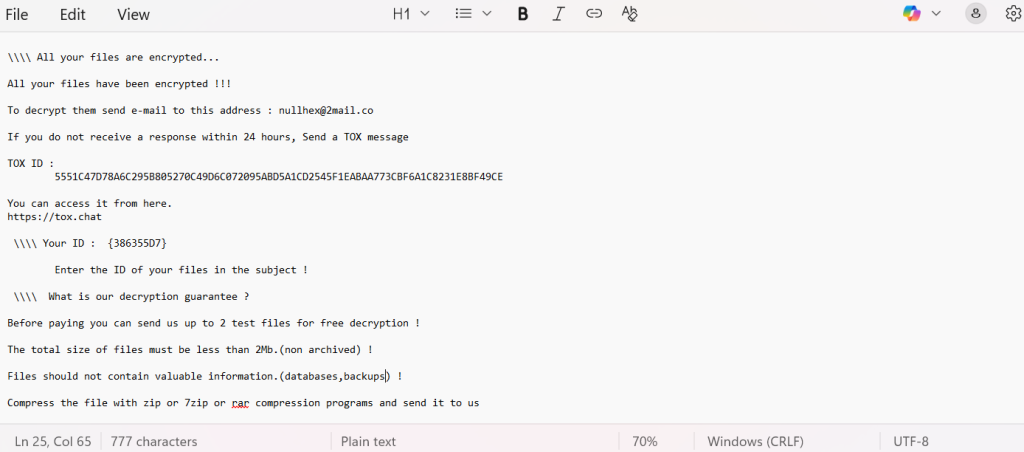
\\\\ All your files are encrypted…
All your files have been encrypted !!!
To decrypt them send e-mail to this address : nullhex@2mail.co
If you do not receive a response within 24 hours, Send a TOX message
Before paying you can send us up to 2 test files for free decryption !
The total size of files must be less than 2Mb.(non archived) !
Files should not contain valuable information.(databases,backups) !
Compress the file with zip or 7zip or rar compression programs and send it to us
Promises free decryption of 2 files (<2MB) to prove authenticity
This ransomware targets small to mid-sized businesses, NAS devices, and Windows servers by exploiting weak passwords, open RDP, and unpatched software vulnerabilities.
How C77L / Nullhexxx Works: The Inside Look
Initial Access Vectors
RDP and VPN Brute-Forcing: Using credential stuffing and weak passwords
Exposed NAS Devices: Exploiting outdated firmware and open SMB shares
Phishing: Malicious email attachments that execute the payload
Deletes shadow copies using Windows commands to disable recovery
File Example:
photo.png.[nullhex@2mail.co].386355D7
#Recover-Files.txt
Tools, TTPs & MITRE ATT&CK Mapping
Credential Access Tools:
Mimikatz
LaZagne
Network Recon Tools:
Advanced IP Scanner
SoftPerfect Network Scanner
Defense Evasion:
PowerTool and Process Hacker used to disable antivirus
BYOVD (Bring Your Own Vulnerable Driver) methods occasionally reported
Exfiltration Tools:
WinSCP
FileZilla
RClone
Mega.nz
MITRE ATT&CK Mapping:
T1003: Credential Dumping
T1078: Valid Accounts
T1486: Data Encryption
T1567: Exfiltration Over Web Services
T1048: Data Exfiltration via Alternative Protocols
Mitigations and Best Practices
Secure Remote Access: Enforce MFA for VPN and RDP logins.
Patch Management: Keep NAS firmware and OS updated.
Network Segmentation: Separate backups and sensitive systems.
Offline Backups: Maintain immutable or air-gapped backups.
Continuous Monitoring: Deploy EDR and SIEM tools to detect early encryption activity.
Driver Control: Prevent use of unsigned or vulnerable kernel drivers.
Conclusion: Restore Your Data, Reclaim Your Network
C77L / Nullhexxx ransomware is a serious hybrid-encryption threat that can devastate organizations in minutes. However, swift isolation, forensic preservation, and professional recovery can restore data safely without funding cybercrime.
Our C77L Decryptor has already helped victims of .386355D7 variants regain access to critical files and resume operations securely. Stay calm, preserve evidence, and act quickly — your recovery begins the moment you take control.
Frequently Asked Questions
Currently, no free universal decryptor exists for .386355D7 variants. Older versions may be recoverable in rare cases.
Yes. It contains your Decryption ID, which is crucial for mapping encryption parameters.
Costs depend on data size and environment. Enterprise cases may range from tens to hundreds of thousands of dollars.
Yes. Our decryptor supports recovery on NAS and ESXi systems, depending on variant type.
Yes. All sessions are encrypted, logged, and verified for file integrity.
No. Payment does not guarantee recovery and could encourage further attacks.
Contact Us To Purchase The C77L / Nullhexxx Decryptor Tool
Introduction Spring ransomware, a notable variant from the infamous Conti ransomware family, has emerged as a formidable cybersecurity threat. Its ability to infiltrate systems, encrypt critical data, and demand hefty ransoms has caused widespread disruption for individuals and businesses alike. As ransomware attacks grow in sophistication and frequency, recovering encrypted data has become a highly…
Understanding the Midnight Ransomware Epidemic Midnight ransomware has rapidly evolved into a prominent cyber threat, notorious for infiltrating computer systems, encrypting sensitive data, and coercing victims into paying exorbitant ransoms to regain access. As its techniques grow more complex and its reach expands, recovering from such an attack has become increasingly difficult for both individuals…
Forensic Dissection of Mimic Ransomware: Analyzing the Massive “Echo” Extension and Interrupted Execution Vectors Strategic Intelligence Briefing: The Mimic (Pay2Key) Architecture Global incident response telemetry has cataloged a highly distinctive ransomware campaign operating under the Mimic (historically tied to Pay2Key) lineage. Often misidentified by automated systems due to its exceptionally long, Base64-like file extensions—such as…
Introduction: The Rising Menace of Silent Ransomware Silent ransomware has emerged as a dangerous and highly effective form of cyberattack. By infiltrating systems, encrypting essential files, and then demanding payment for their release, this malware has devastated both individuals and large-scale organizations. As the sophistication of such threats increases, so does the challenge of reclaiming…
Backups ransomware has evolved into a formidable menace in the cybersecurity world, disrupting systems, encrypting sensitive data, and extorting victims with monetary demands. As these attacks grow in scale and sophistication, retrieving locked files becomes increasingly complex for both private users and enterprises. This article explores the nature of Backups ransomware, its devastating implications, and…
Introduction to the Threat In the ever-evolving landscape of cybersecurity, Hunters ransomware has emerged as a formidable foe, infiltrating systems, encrypting vital files, and demanding ransom in exchange for decryption keys. As the frequency and sophistication of these attacks escalate, individuals and organizations are faced with the daunting task of data recovery. This exhaustive guide…


One Comment